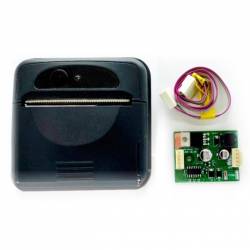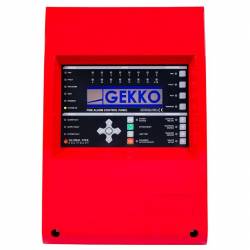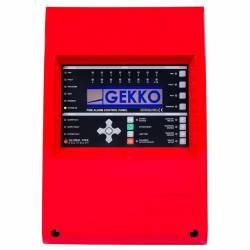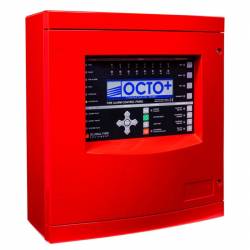


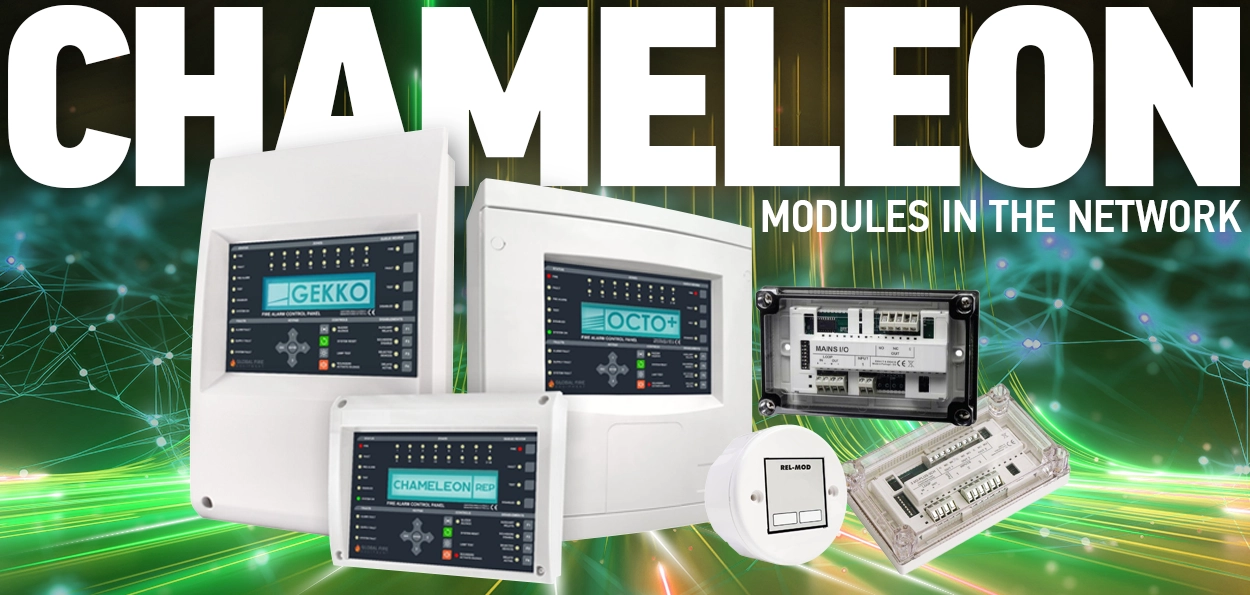
One of the biggest advantages of the Distributed Intelligence Global Fire Chameleon Network is that if one centre fails, all centres will report it, but the system will continue to work. A network can contain up to 32 devices, which can include a Gekko, Octo+ control panel, Node+ expander and Chameleon Repeater secondary.
Benefits of Chameleon Network
As a global system, all panels share a "cause and effect" configuration. Each time an event occurs on a panel, the panel transmits it across the network and records it in its local "event log", and then executes the cause and effect relationship (control and triggering of beeps) defined for that event.
In the event of a partial failure or disconnection of the network, the panels will signal the failure, but the disconnected panel can continue to operate in "island" mode. To transfer controls and inputs, it is essential to configure the parameters at system level. Anyone who works with Global Fire control panels is no stranger to the fact that I/O module outputs can be freely assigned to control groups, which groups can be assigned to zones. This logic has been extended with the advent of the new control panels to the extent that any module in any panel in the network can be freely assigned to any control group. Thus, even the modules of a control group assigned to the zone of the "01" centre (which may include elements from another centre) can be assembled from elements of any centre.
In the video below, we present the Chameleon Network and the centres you can use to set it up:
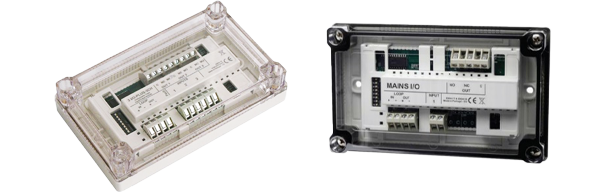
3 I/O PLUS and MAINS I/O modules
The 3 I/O PLUS modules allow the connection of external devices and equipment to the fire alarm panel, on the input side. These inputs are resistor controlled, dry relay contacts are required on the sending device. The connection of the inputs is supervised for fault (open or short circuit) and alarm conditions. The interface can be used to control external devices that need to be controlled by the fire alarm system, such as the fault output of auxiliary power supplies supplying door holders or additional devices. On the output side, the connection of the devices to be controlled to the fire alarm panel can be made by means of normally open dry relay contacts (2 A - 30 V DC / 0,5 A - 125 V AC). A distinction is made between 1, 2 and 3 channel modules. The modules occupy an address on the loop depending on the number of channels.
The MAINS I/O modules can be used to directly control 230 V equipment on the output side (8 A - 230 V AC or 30 V DC), the input side is the same as the 3 I/O PLUS modules. No external 24 V auxiliary power supply is required for the modules as these devices are loop powered.
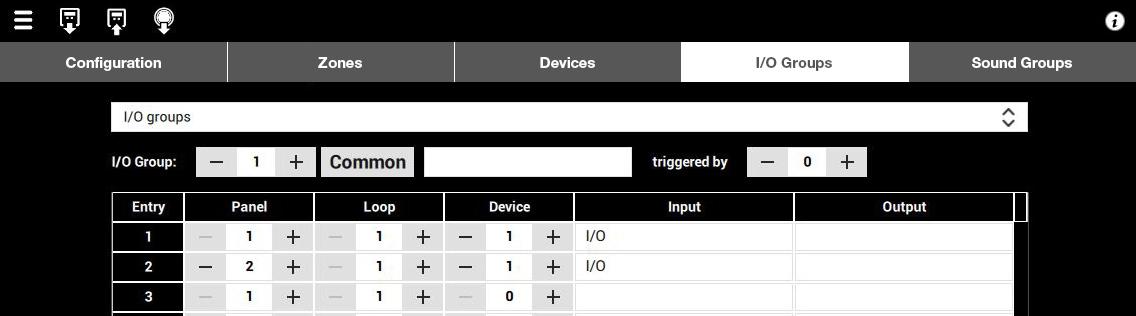
The screenshot below shows I/O Group 1, which consists of the control module on the first loop of the first hub of the Chameleon network and the control module on the first loop of the second hub of the network.
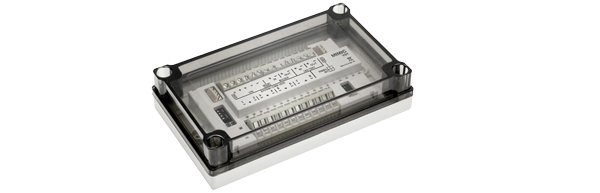
MULTI I/O module
The module is, as the name suggests, a multifunctional interface module providing four conventional zones, three conventional audio signal control outputs and two system auxiliary relays. The module requires an external 24 V DC auxiliary power supply. A dedicated green LED indicates if power is available. The module has selectable active or resistive line-end supervision on the conventional zone inputs. Two LEDs indicate the status of each zone. The red LED indicates a fire and the yellow LED indicates a fault in the zone. The loop monitors for open circuits/short circuits. For the controlled audible outputs, the maximum combined current rating for S1, S2 and S3 is 1 A. The device occupies seven addresses on the loop due to the four consecutive conventional zone outputs and three audible outputs.
Whether it is an addressable beeper, a motherboard conventional beeper or a beeper loop inserted by a beeper control module, beeper groups created in the Chameleon Network can be freely varied in a similar way to I/O groups.
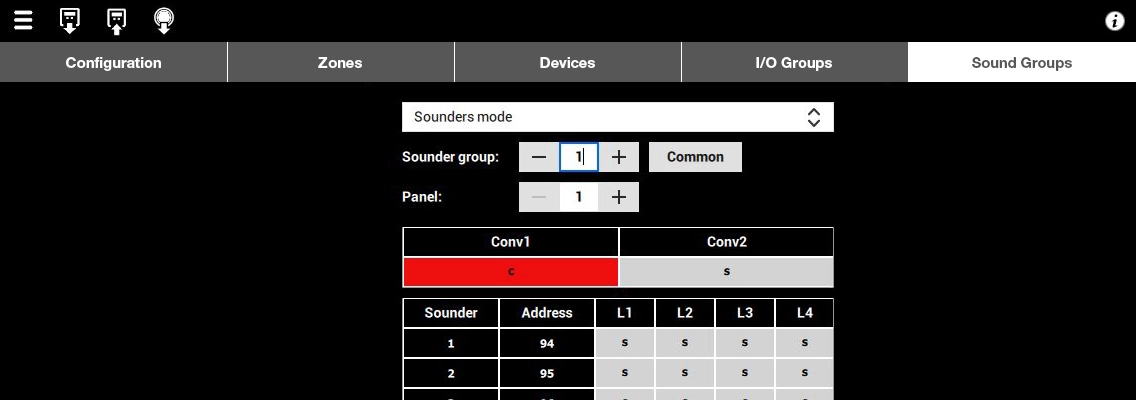
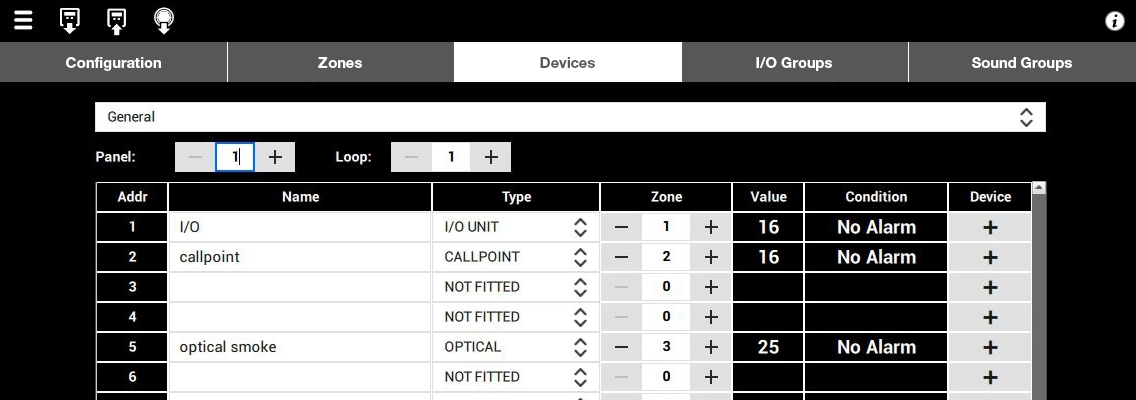
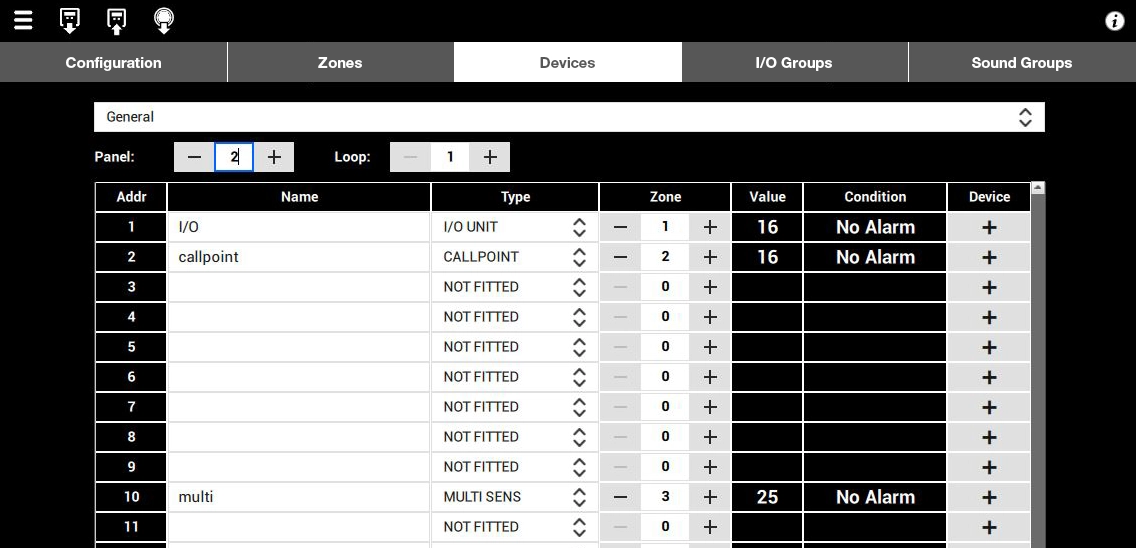
In the two screenshots below, you can clearly see that a signalling zone can have multiple centre loops thanks to the Chameleon Network.
Chameleon Network
The best thing about the development is that the entire menu structure has been retained, so the programming flow will be completely familiar, without having to learn a whole new system. This has been extended with a few menu items to handle larger frame numbers and to cover network operation.
From now on, we don't have to compromise on protecting objects with multiple parts by necessity with only a large center.
Thanks to new developments, we can now choose the most optimal design, while increasing the security and redundancy of the data communication network!
Previously installed systems can be integrated without any problems, while both old and new systems are guaranteed for life. New modules, distributed intelligence and system-level cross-controls ensure a high degree of flexibility, efficiency and security.
The already scalable Global Fire systems have now been taken to the next level. While retaining simplicity and inherent efficiency, they have increased feasible size and improved optimisation.
The new control panels, modules and accessories are available in our webshop and in our stores!